

When the cartilage(cushion) around the bones wears away gradually it results in bone-to-bone friction due to an absence of the lubricating cartilages causing joint pains. There is a lot of medication available to ease the pain and help reduce the shrinking of the cartilage tissues of the joints, but after a certain level of medication, surgery might be the only viable option for the final relief.
It is important to have understood the benefits from the Doctor and then move ahead to find out the facility that is specialized and reputed in performing such surgeries for successful outcome. You may have pain while activity of daily living, like stair climbing, walking, getting up from a sitting position. You can experience pain radiating to your knee joints.
If this pain is not getting relieved with medications, surgical replacement of hip is the final option. In medical literature, the total hip replacement surgery has been conducted since the 1960s and consists of replacing the damaged cartilage tissues with a metal cup socket connecting to the hip bone.
WHAT IS DONE?
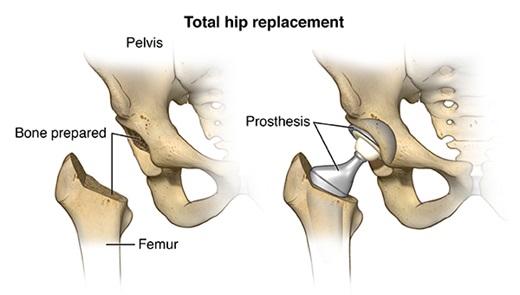
The ball and socket joint mimics the socket of the pelvic region and the ball from the femur bone. When the cartilage has affected the space between the joints gets narrower than usual. The total hip replacement or total hip arthroplasty, these damaged bones and cartilage are completely removed and replaced with prosthetic implant . The damaged femur bone head is replaced with a metal stem, whereas the metal or ceramic ball is placed on the upper part of the stem for mimicking the joint and finally, the damaged cartilage of the pelvic part-acetabulum is replaced with a metal socket. There is a metal, plastic or ceramic spacer allowed between the ceramic ball and socket to allow easy gliding and mimicking the space between the joints mentioned earlier, this causes complete pain free moment of the hip joints.
The surgeon and jointly the patient can decide on the choice of implant- cemented or uncemented as well as the surgical approach- anterior or posterior. Both the approaches have their advantages as well as limitations.
Pre-operative steps
Every effort is made to assess the patient prior to surgery in order to ensure safety of the patient for the elective procedure.
1. After admission, routine blood work-up will be done prior to surgery. Depending on the age of the patient and other premorbid conditions, other investigations such as Echocardiography may be performed.
2. All the investigations prior to surgery are performed in order to ensure that the surgical procedure can be safely tolerated by the patient, since joint replacement is an elective procedure. If any risk is involved, the patient/ attendants will be informed so.
3. X-rays and/or CT/MRI may be done depending on the surgeons’s choice and the surgical indication for hip replacement.
4. Surgical consent will be explained to the patient detailing the procedure as well as the risks involved, if any.
Intra-operative Steps
1. Skin Incision: 10-15 cm incision in made through the skin (either from front-anterior or the back portion of hip joint) Though many options are there on the choice of approach to the hip joint, Most commonly used approach is posterior approach. Direct anterior approach, Though has a steep learning curve, has shown reduced dislocation rates and can be considered in lean individuals.
2. After skin incision, subcutaneous fat and muscles are separated.
3. Hip Joint capsule is exposed and incised.
4. Hip joint is exposed with pelvic bone(acetabulum- The socket) and the Femur head (Thigh bone tip- The ball)
5. Damaged femoral head is dislocated and then cut with power saw and removed.
6. Acetabulum is exposed and sequential reaming (shaping) is done with increasing sizes.
7. Once appropriate size is decided, acetabulum cup is fixed into position with correct anterversion(angle) - cemented or uncemented depending on the bone quality, patient characteristics and choice of the operating surgeon.
8. Ceramic on ceramic, metal on poly and metal on metal are the options for the liner, metal on poly showing superior results at present.
9. After acetabular preparation, femoral preparation is done and serial broaching( canal opening) is done with broaches of increasing sizes
10. After final size is decided, femoral stem fixation is followed by femoral head fixation, the size depending on stability.
11. The new joint is finally reduced (brought in position/ undislocated) and stability is assessed.
12. After thorough cleaning the joint, wound closure is done followed finally by skin closure and dressing.
Post-operative Management:
Day 1: Immediately on first day after the surgery, depending on the surgical outcome as well as the patients overall status including bone quality, mobilization- full weight bearing with walker is started. Apart from mobilization, patients are advised to start quadriceps strengthening exercises.
The patient might experience some amount of pain which should normally subside within 2-4 weeks. There is a chance the surgical wound might soak with blood, though its nothing much to worry about, but its always good to inform you operating surgeon
Day 2-3: On second day, the patient is continued with physiotherapy exercises as on day 1. Along with that the patient is taught on how to ascend/descend the stairs.
Dressing is normally done on day 3 of the surgery.
Day 4-7: The pain reduces from at the time of surgery. If any soakage/discharge from the wound is present, it is always good to inform the operating surgeon.
By this time the patient is normally discharged from the hospital and is advised to continue with home exercises at least twice a day for 10 minutes.
Week 2-6: The pain will substantially reduce for upto 12 weeks as compared to immediately after surgery. The patients should continue the exercises and follow the do’s and don’ts as advised by the operating surgeon.
Sutures are normally removed 15 days after the day of surgery. If there is some gaping in the wound, the surgeon will recall you after 3-7 days for removal of the remaining suture.
After the removal of sutures, wound can be washed with water .Patients should avoid massaging the wound as it may lead to bone overgrowth in soft tissues(heterotopic ossification)which can be problematic later on.
Week 6- 12: A check xray is routinely done at 6 weeks after the surgery in order to see the alignment and fixation. Depending on the condition, most of the patients are advised to reduce from walkers to crutches or walk without support.
After a Hip Replacement surgery, one stays in the hospital for about 4-6 days and it can take around 6 months for recovery. It is essential to take care of certain things to avoid dislocation of the replaced hip and to gain complete recovery :
Do's -
1. Carefully follow the instructions given by your doctor.
2. Posterior Approach- ALWAYS Use a pillow between your legs while sitting and/or resting .
3. In case of swelling around your hip, tie a towel with some ice cubes wrapped in it.
4. Light activities like walking and exercises recommended by your doctor should be done daily.
5. Keep your surroundings clutter free so that you do not fall.
6. In case of hip replacement done by anterior approach, patient can be advised to squat/ cross legged depending on a case to case basis.
7. Swelling after the surgery on the operated limb is normal for upto 6 months. Patients can elevate the limb over a pillow while sleeping or apply a crepe bandage during the night time. Though, If the swelling is severe, consult your doctor.
8. If the pain is severe, medications should be taken and exercises should be continued instead of avoiding the medications and not doing exercises.
Don'ts :
1. Avoid climbing stairs or doing any intense activities like running, aerobics etc.
2. Do not try to turn or twist your hip suddenly.
3. Do not cross your leg by knee/ankle or bend your hip sideways.
4. Avoid sitting in a low couch/chair or on the floor.
5. Avoid driving before consulting the doctor.
The above is a basic guidelines for all the patients. If in any discrepancy, it is always the best to consult your doctor and follow his orders.