

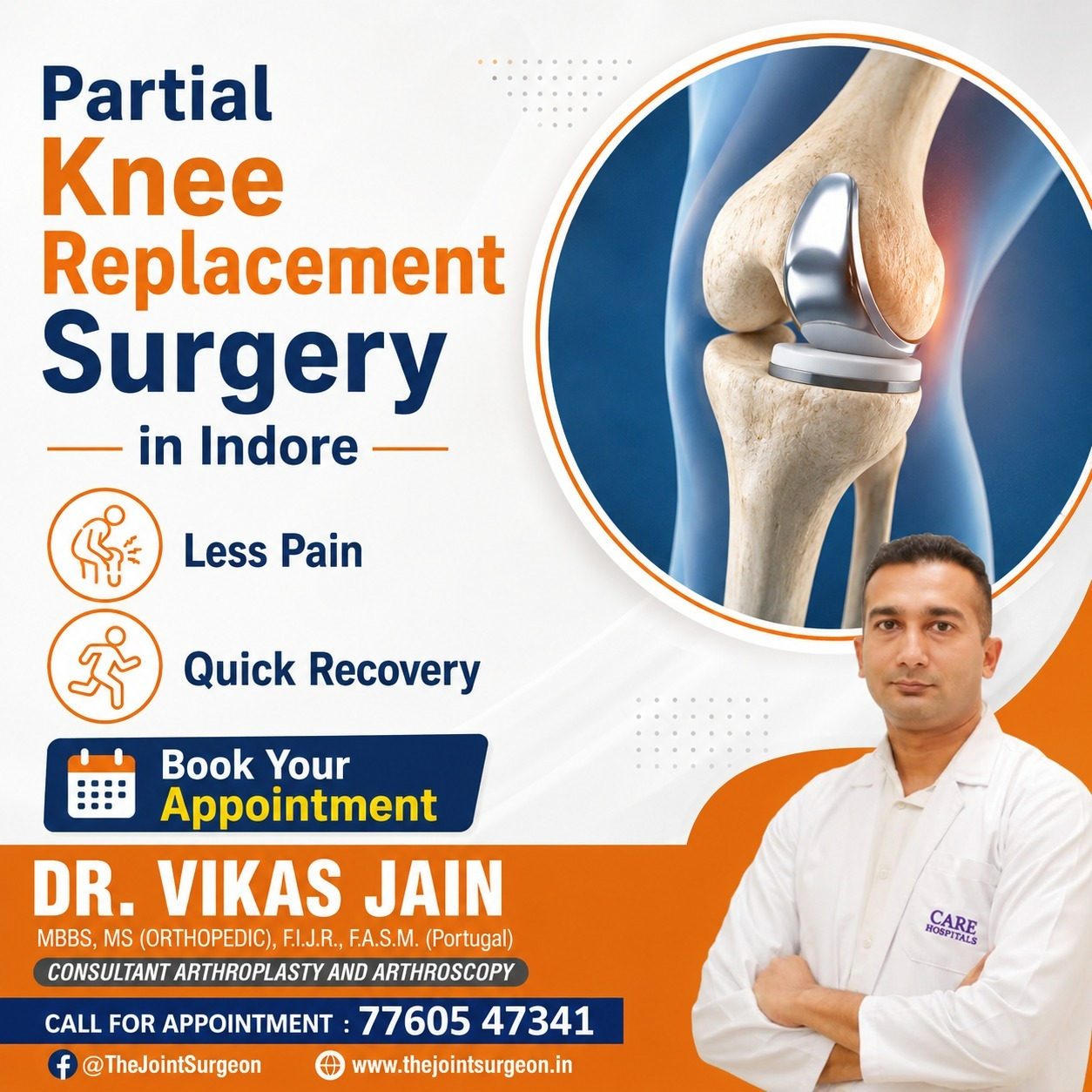
Partial Knee Replacement Surgery Indore
Persistent knee pain can make daily activities like walking, climbing stairs, standing, or exercising difficult. When knee arthritis affects only one part of the knee and conservative treatment doesn't provide sufficient relief, partial knee replacement surgery may be considered for eligible patients.
Dr. Vikas Jain, an orthopedic and joint replacement surgeon Indore, specializes in the diagnosis and treatment of knee and hip conditions, including joint replacement procedures. His clinical interests include knee replacement, hip replacement, hip resurfacing, and sports-related orthopedic conditions.
What is Partial Knee Replacement Surgery?
Partial knee replacement, also known as unicompartmental knee replacement, is a surgical procedure that replaces only the damaged part of the knee joint, while preserving the healthy compartment and supporting structures as much as possible. The knee has three main compartments:
* Medial compartment – the inside of the knee
* Lateral compartment – the outside of the knee
* Patellofemoral compartment – the area between the kneecap and the thighbone
In some patients, arthritis primarily affects one area, while the rest of the knee remains largely healthy. In such cases, partial knee replacement may be an option instead of replacing the entire knee joint.
Who might need a partial knee replacement?
Partial knee replacement is usually considered after a detailed orthopedic examination. A patient may be considered if:
* Arthritis is primarily localized to one area of the knee
* Knee pain significantly impacts daily activities
* Conservative treatment has not provided adequate relief
* The knee has adequate ligament stability
* The remaining cartilage and joint tissue are reasonably healthy
* The patient's symptoms and imaging results are consistent with local joint damage
Not every patient with knee arthritis is a candidate for partial knee replacement. A specialist evaluation is essential to determine whether partial or total knee replacement is appropriate.
Symptoms that may indicate advanced knee damage
Patients with localized knee arthritis may experience:
* Persistent knee pain
* Pain when walking or climbing stairs
* Knee stiffness
* Difficulty standing for long periods of time
* Swelling around the knee
* Reduced knee movement
* Pain after physical activity
* Difficulty performing daily tasks
* Pain that gradually becomes more frequent or severe
If knee pain is affecting your mobility or quality of life, an orthopedic consultation can help determine the underlying cause.
Partial vs. Total Knee Replacement
The main difference is how much of the knee joint is replaced.
Partial Knee Replacement:
Only the damaged part is replaced, while healthy parts of the knee can be saved.
Total Knee Replacement:
Damaged surfaces in multiple parts of the knee are replaced with prosthetic parts. The choice depends on factors such as the location and extent of arthritis, ligament condition, knee alignment, age, activity level, imaging results, and overall joint health.
Potential Benefits of Partial Knee Replacement
For the right patients, partial knee replacement can offer several potential advantages:
* Preservation of more healthy areas of the knee
* Smaller joint resurfacing area compared to total replacement
* Potentially faster rehabilitation in the right patients
* Preservation of a more natural knee structure
* Relief of pain caused by the damaged area
* Improvement in mobility and daily activities
However, results vary from person to person, and partial knee replacement is not automatically better or more effective than total knee replacement. Selecting the right patient is an important part of treatment planning.
Diagnosis Before Partial Knee Replacement
Before recommending surgery, an orthopedic specialist may consider:
1. Medical history – the timing, location, and severity of symptoms.
2. Physical examination – knee movement, stability, alignment, tenderness, and walking pattern.
3. Imaging – X-rays and, when medically indicated, additional imaging can help assess the condition of various parts of the knee.
4. Ligament condition – Ligament stability is essential for partial knee replacement.
5. Overall joint condition – The health of other parts is assessed before determining the appropriate procedure.
The final treatment decision should be based on a clinical assessment, not just symptoms.
Partial Knee Replacement Surgery Indore
Patients undergoing partial knee replacement surgery in Indore can consult Dr. Vikas Jain to evaluate knee arthritis and other orthopedic conditions.
Consulting a specialist can help determine whether knee damage is too localized for partial replacement or whether another treatment may be more appropriate.