
Ligament Surgery Specialist in Indore – Dr. Vikas Jain
Expert Orthopedic Consultation for Ligament Injuries, Sports Injuries, and Knee Stability
Ligament injuries can affect your ability to walk, run, exercise, climb stairs, and perform daily activities. Whether caused by a sports injury, a sudden twist, a road accident, or a sudden fall, ligament damage can cause pain, swelling, joint instability, and restricted movement. A timely examination by an experienced orthopedic specialist can help determine the severity of the injury and determine the appropriate treatment.
If you're looking for a ligament surgery specialist in Indore, Dr. Vikas Jain provides orthopedic consultations for people with ligament problems and joint injuries. Treatment recommendations depend on the affected ligament, the severity of the injury, activity level, age, and the overall condition of the joint.
From initial diagnosis and non-surgical treatment to surgical treatment when recommended, the goal is to help patients improve joint stability, ease movement, and safely return to their daily activities.
Consult a ligament surgery specialist in Indore.
Ligaments are strong bands of connective tissue that connect bones and help stabilize joints. They control extensive joint movement and provide support during activities like walking, running, jumping, and twisting. When a ligament is stretched, slightly torn, or completely torn, the affected joint can become painful or unstable. Some injuries heal with proper rehabilitation and conservative treatment, while others may require surgery. Dr. Vikas Jain provides orthopedic consultation to patients with symptoms related to ligament injuries. A detailed clinical assessment helps determine whether surgery is necessary or whether non-surgical treatment is appropriate. Patients should not ignore recurring joint instability, swelling, or difficulty bearing weight after an injury. Early medical examination can help prevent further damage and plan appropriate treatment. What are ligament injuries? Ligament injuries occur when the connective tissue supporting a joint is stretched beyond its normal limits or torn due to excessive force. These injuries are commonly associated with sports activities, sudden changes in direction, falling awkwardly, direct impacts, and accidents. Ligament injuries are generally divided into three grades:
Grade 1 – Mild ligament injury
Grade 1 injuries involve stretching or minor damage to ligament fibers. Patients may experience mild pain and tenderness, but joint stability is usually maintained.
Treatment may include rest, activity modifications, appropriate pain management, and physiotherapy, depending on clinical assessment.
Grade 2 – Partial Ligament Tear
A Grade 2 injury involves a partial tear of a ligament. Common symptoms include pain, swelling, limited movement, and some degree of joint instability.
Treatment depends on which ligament is affected, the extent of the tear, and the patient's functional needs.
Grade 3 – Complete Ligament Tear
In a Grade 3 injury, the ligament is completely torn. This can cause significant joint instability and difficulty performing physical activities.
Some complete ligament tears can be treated without surgery, while others may require ligament reconstruction or another surgical procedure. This decision depends on the affected joint, associated injuries, and the patient's individual needs.
Types of Ligament Injuries Treated by Orthopedic Specialists
Ligaments are located in various joints throughout the body. Knee ligament injuries are particularly common in athletes and physically active individuals.
1. ACL Injury – Anterior Cruciate Ligament Tear
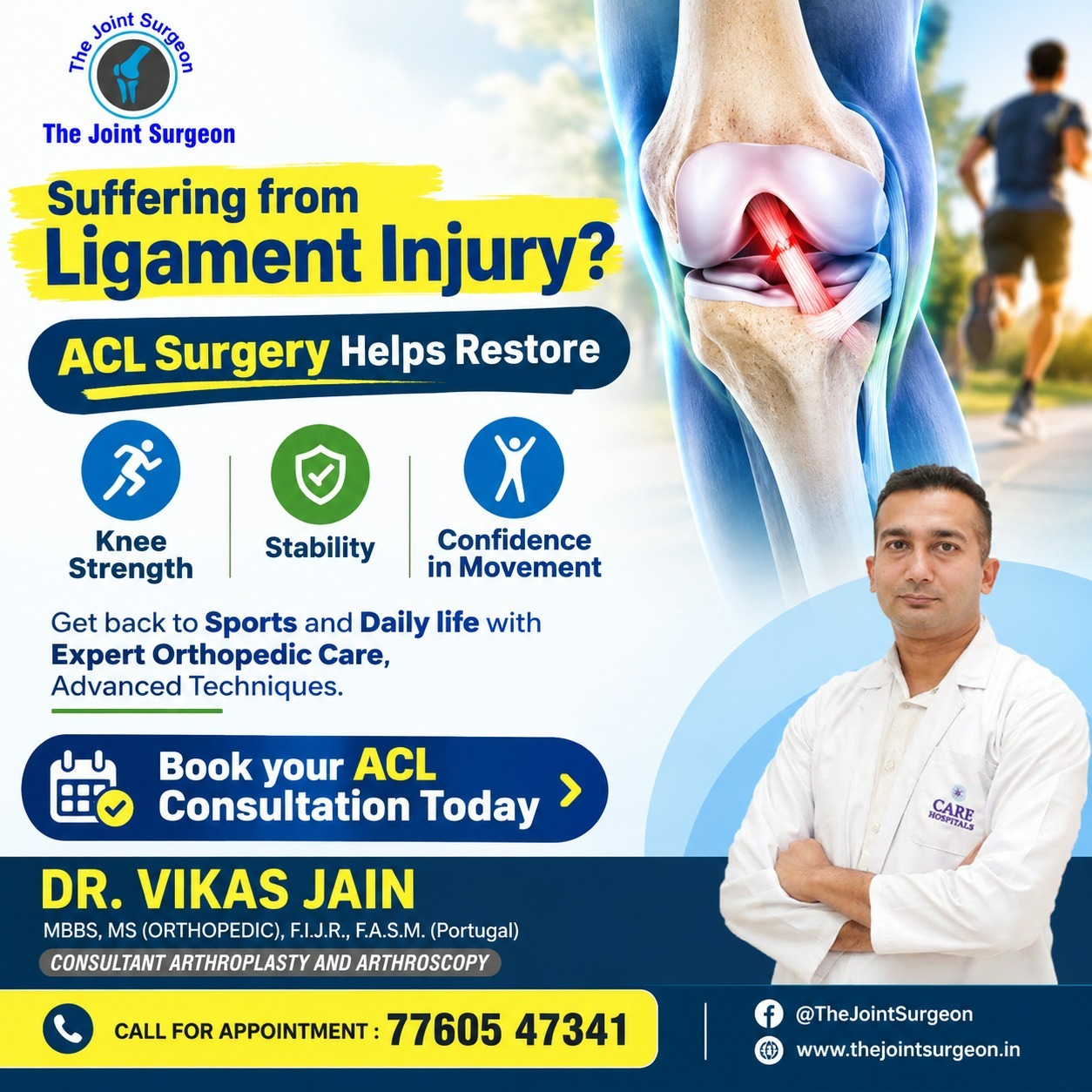
The anterior cruciate ligament (ACL) is one of the main stabilizing ligaments of the knee. It helps control forward movement and rotational stability of the knee joint.
ACL injuries can occur during football, cricket, basketball, badminton, and other activities that involve sudden stopping, jumping, or changing direction.
Common symptoms of an ACL injury:
* A popping sensation at the time of injury.
* Sudden pain in the knee.
* Swelling after the injury.
* Difficulty continuing sports activity.
* Feeling as if the knee might give out.
* Decreased confidence when walking or changing directions.
An ACL tear does not necessarily mean surgery is necessary. However, patients who have significant instability, increased activity requirements, or associated injuries may be considered for ACL reconstruction after a proper evaluation.
2. PCL Injury – Posterior Cruciate Ligament Tear
The posterior cruciate ligament (PCL) helps prevent the shin bone from moving too far back relative to the thigh bone.
PCL injuries can occur from direct impact to the front of the knee, especially during road accidents or sports injuries.
Possible symptoms include:
* Pain in the back of the knee.
* Swelling.
* Difficulty walking.
* Stiffness in the knee.
* Feeling unstable.
* Difficulty climbing stairs.